A middle manager at Nokia once told researchers what it felt like to sit in a review meeting, knowing a deadline was wildly optimistic: "I thought I should point it out, but the thought of challenging [top managers] made my heart race, and then I just kept quiet."
Most of us have felt that. Most of us have also been the boss someone kept quiet around.
Management research has been quiet about those managers too. 786 to 66 (the first version of this count; see the update below). That's how many abstracts in 21 core management journals, 2007 to 2018, mention top executives versus middle managers, by keyword.
About twelve to one. Correct for the papers keyword searches miss and it's still about 10 to 1, a provisional estimate (how I counted is at the end). Plenty of people do study the middle: Bill Wooldridge and colleagues reviewed 25 years of that work in 2008.
At the end of this edition, I'm releasing the first public version of my model for running change from the middle, the Unfrozen Loop, and asking you to break it.
Why it matters
Executives decide what changes. Middle managers decide what it means on Monday morning: which old habit stops, who gets retrained, what happens when the new system breaks during the busiest week of the quarter. Describing how organizations made the sudden shift to working from home happen, McKinsey's Emily Field said: "It came down to the managers."
Practice has the same blind spot. Prosci's benchmarking research, built on more than 10,800 responses from change practitioners across 12 editions, ranks executive sponsorship first among seven contributors to change success. Supporting people managers ranks seventh. Prosci also reports that 63 percent of the practitioners it surveyed said their organization didn't adequately prepare managers and supervisors with the skills, training and tools to lead change.
So research mentions this layer far less, we don't prepare it, and then we blame it.
If you lead change, that silence is your problem too. The managers who go quiet are the ones who could have told you the deadline was wrong while there was still time to fix it.
Try this before you read on. Pull up the last change announcement at your company. Count the sentences that name who has to make it work on Monday morning. If the answer is zero, you've found the gap.
Meanwhile, managers are wearing out. Gallup's global measure of manager engagement fell from 30 percent in 2023 to 22 percent in 2025.
Afraid, stuck, and what works
Afraid: Nokia. In 2016, Timo Vuori and Quy Huy published the inside story of how Nokia lost the smartphone race, based on 76 interviews. Nokia saw the iPhone coming. A middle manager flagged the touch-screen gap a year early, and the CEO forwarded it with "Please take action on this."
The researchers traced the failure to fear, not the warning. Nokia's leadership had a history of blowing up at bad news, so middle managers learned to over-promise. That's where the quote at the top of this edition comes from. Top managers, afraid of competitors and shareholders, didn't fully reveal the real size of the threat to the people below them. Nokia's touch-screen answer to the iPhone, the 5800, shipped about a year and a half late. In 2013, it agreed to sell its phone business to Microsoft.
Stuck: LEGO. LEGO cut its production managers from 72 to 45 and told the survivors to run self-managing teams. Their division director saw them as "paralyzed." Researchers Lotte Lüscher and Marianne Lewis spent more than two years helping them work through it, including 118 one-on-one and team "sparring" sessions. The managers were stuck on contradictions: be in charge but let the team decide, build the team but hit the numbers. One said: "We seem to be waiting for the organizational changes to stop so we can get to work... But we are also supposed to be implementing the changes."
The sessions helped. But the mandates from the top stayed ambiguous, and at the final review the managers agreed they were becoming more, not less, frustrated with the changing organization. They came to accept the ambiguity as part of the change, but the researchers called that acceptance precarious. Help in the middle only went so far while the top stayed ambiguous.
What works: two newer studies. In a 2017 study, Mariano Heyden and colleagues surveyed 1,795 employees in 468 organizations going through change. Employees backed change started by top managers no more than average. They backed change started by middle managers more than average, especially when top managers then handled the execution. That pairing was the rarest one they found.
In a study published in 2022, Guido Friebel and colleagues reported a randomized trial in a retail chain. The CEO asked a randomly chosen group of store managers to "do what they can" to reduce employee quits, and left the how to them. Quits in those stores fell by a fifth to a quarter, with no drop in sales. After about nine months the effect faded. A reminder brought it back, briefly.
The top set the intent, the middle chose the method, and it only lasted as long as someone kept coming back to it.
What the Army taught me, both ways
On paper, the Army gets the middle right. It calls its noncommissioned officers "the backbone of the Army," and its doctrine for command, mission command, "empowers subordinate decision making and decentralized execution": leaders state the intent, and the people closest to the problem decide how.
In the units I served in, it often worked the other way. In combat, not following an order can cost lives, so the habit of doing what you're told gets trained in deep. It didn't switch off back at the motor pool, where the stakes were a deadline. Good ideas that would have saved hours never got said out loud. Speaking up felt riskier than staying quiet.
One Army habit is worth stealing anyway. After training events, the unit runs an after-action review. A 2013 meta-analysis of 46 samples found that properly run debriefs improve performance by about 20 to 25 percent.
Most companies have no battlefield, and they still build the same habit. The plan says "empower your managers." The culture says "don't make waves." The managers believe the culture.
Launching the Unfrozen Loop, version 0.1
Last edition I argued Lewin never said "refreeze." This edition I'm bringing it back, on a timer, because the evidence made me.
Here's the first version of the model I said I'd build in public. After I drafted it, I went looking for studies that contradict each part. Several parts didn't survive unchanged.
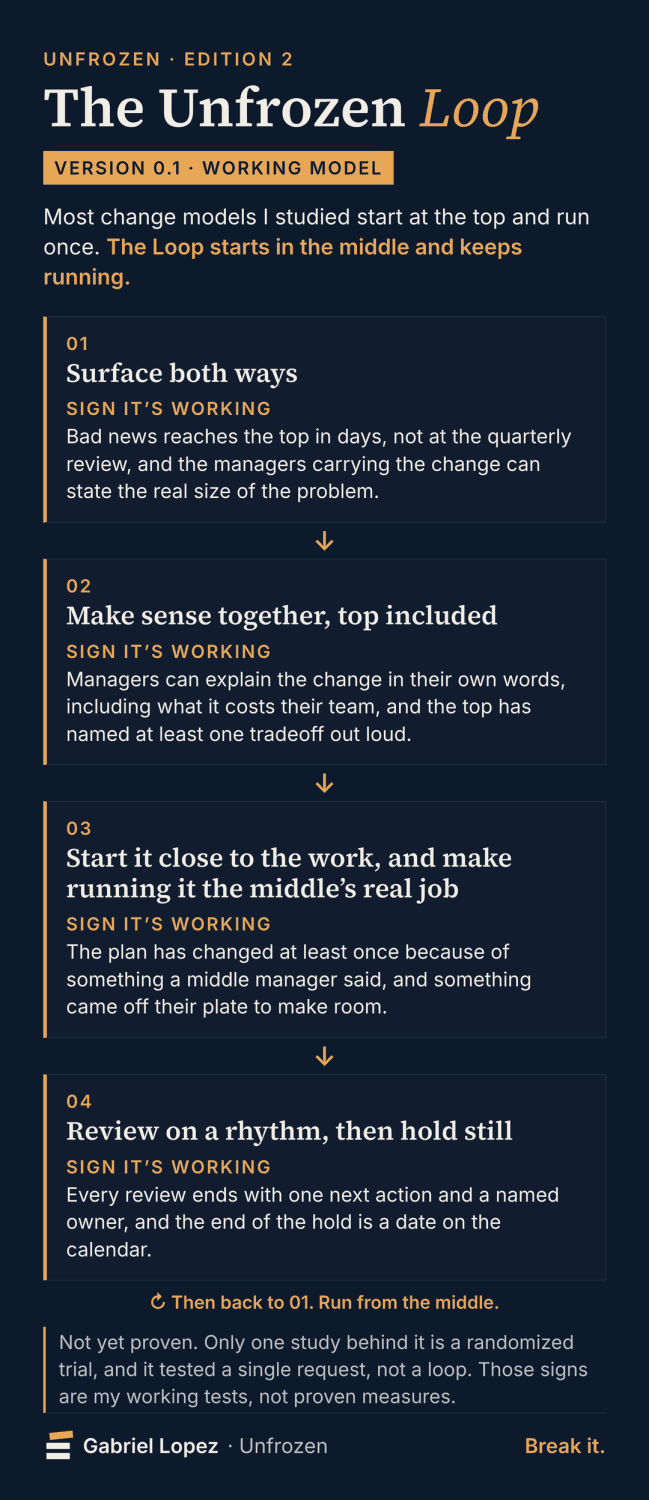
None of these parts is new on its own. Ikujiro Nonaka argued for "middle-up-down" management in 1988, and Karl Weick and Robert Quinn described continuous change as "freeze, rebalance, unfreeze" in 1999. What I'm testing is whether running them as one loop, from the middle, works better than the usual top-down sequence.
Most change models I studied start at the top and run once. The Loop starts in the middle and keeps running. For each part, I've added the sign I'd look for to know it's really happening. Those signs are my working tests, not proven measures.
1. Surface both ways. Bad news travels up without fear, and the real size of the problem travels down without spin. At Nokia, the warning arrived. The reaction to it is what failed.
Sign it's working: bad news reaches the top in days, not at the quarterly review, and the managers carrying the change can state the real size of the problem.
2. Make sense together, top included. Middle managers and their teams work out what the change means, and the top names the tradeoffs instead of denying them. LEGO shows what happens when it doesn't.
Sign it's working: managers can explain the change in their own words, including what it costs their team, and the top has named at least one tradeoff out loud.
3. Start it close to the work, and make running it the middle's real job. The people who carry the change shape it inside a stated intent, the top puts its weight behind them, and the work gets taken off their plate to make room. When one company invited frontline employees into strategy and recast its middle managers as facilitators, researchers watched those managers quietly take control back.
Sign it's working: the plan has changed at least once because of something a middle manager said, and something came off their plate to make room.
4. Review on a rhythm, then hold still. Scheduled reviews that end in a named next action, alternated with real periods of no new change. In a study of 67 European insurers, companies that changed on a regular rhythm, alternating change and stability, outperformed those that changed irregularly. Refreeze on purpose, for a stated interval, then review.
Sign it's working: every review ends with one next action and a named owner, and the end of the hold is a date on the calendar. That date, and the middle running the review, are what separate this from continuous change as usual.
Where this isn't proven yet: only one study behind it is a randomized trial, and it tested a single request, not a loop. The largest field study behind it measured support for change, not results. And nothing here shows this beats a well-run executive-led transformation. It's a bet about the common case. I'll test one part per edition, and I'd rather you break it here.
How to break it. Reply with a change you've lived through where one of these four parts was done well and the change still failed, or skipped and it still worked. If your example changes the model, I'll say what changed in the next version and credit you, with your permission.
Find your weakest part. The free Loop Self-Check takes two minutes: ten statements about a change you're living through. It shows which part of the Loop is weakest and links to a free one-page kit for it. unfreeze.us/self-check
Try this on Monday
Before you launch your next change, sit down with the managers who will carry it and ask: "What will make this hard for your team?" Write down the answers. Change the plan based on at least one of them, and tell those managers what you changed and why.
Your turn
Run the Monday step this week, then reply and tell me what your managers said. Middle managers: tell me the one thing you wish executives understood before they rolled out a change. Executives: tell me the last thing a middle manager said that changed your plan. With your permission, the best answers go in Edition 3, and they'll shape the next version of the Loop.
Unfrozen helps the people who carry change get heard, with research you can check and tools you can use on Monday. It comes out every other Thursday. If this was useful, subscribe, and tell me where it's wrong.
How I counted. The headline comes from the Unfrozen Research Index, which holds 34,953 research articles and reviews from 29 management and organizational development journals, published 2007 to 2026 (2026 to date). Keyword counts use the 24,443 abstracts supplied by OpenAlex, a free scholarly database, which cover 28 of the 29 journals (21 core, 7 expansion); OD Practitioner comes only from my doctoral research file and has no OpenAlex abstracts. The headline uses the 21 core journals from 2007 to 2018: 11,138 abstracts. An abstract counts if its title or abstract uses one of a fixed list of terms. Executive terms: CEO, chief executive, top management (team), top managers, TMT, upper echelons, senior executives or leaders, corporate executives, board of directors. Middle terms: middle manager, middle management, mid-level manager. A paper can count as both. Counts measure research attention, not importance, and abstracts understate full papers. A follow-up check of 520 sampled abstracts found keyword searches miss about half the papers in both groups; corrected for that, the core-journal gap is about 10 to 1 (plausible range roughly 6 to 15). That correction is provisional: the coding was automated, and a human coder hasn't checked it yet. My earlier doctoral research file (12,031 abstracts from 22 journals, 2007 to 2018) searched titles, abstracts and subject keywords and found 853 executive and 68 middle-manager abstracts. The index count of 693 to 65 replaces it as the headline, because anyone can rebuild the index and extend it past 2018. Journal list and search terms available on request.
Extend the index count through 2026 (2026 to date) and add seven journals where middle managers come up more often, and the gap narrows: across 28 journals, 1,541 abstracts mention executives and 193 mention middle managers, by keyword: about 8 to 1. Still not close.
Two honest cautions. First, those counts cover every topic, and plenty of executive studies are about pay and boards, not change. When I narrowed my doctoral-file count to abstracts about change and implementation, the gap shrank, but executives still came up more often. Second, researchers sometimes say "supervisor" instead of "middle manager." In my doctoral file, count every supervisor, line manager and team leader and the gap narrows sharply, though most of the extra matches are the single word "supervisor", and few of those studies are about organizational change.
Sources
Friebel, G., Heinz, M., & Zubanov, N. (2022). Middle managers, personnel turnover, and performance: A long-term field experiment in a retail chain. Management Science, 68(1), 211–229. https://doi.org/10.1287/mnsc.2020.3905
Gallup. (2025). State of the global workplace: 2025 report. Gallup, Inc.
Gallup. (2026). State of the global workplace 2026 report. Gallup, Inc.
Heyden, M. L. M., Fourné, S. P. L., Koene, B. A. S., Werkman, R., & Ansari, S. (2017). Rethinking 'top-down' and 'bottom-up' roles of top and middle managers in organizational change: Implications for employee support. Journal of Management Studies, 54(7), 961–985. https://doi.org/10.1111/joms.12258
Klarner, P., & Raisch, S. (2013). Move to the beat: Rhythms of change and firm performance. Academy of Management Journal, 56(1), 160–184. https://doi.org/10.5465/amj.2010.0767
Lüscher, L. S., & Lewis, M. W. (2008). Organizational change and managerial sensemaking: Working through paradox. Academy of Management Journal, 51(2), 221–240. https://doi.org/10.5465/amj.2008.31767217
McKinsey & Company. (2023, June 1). Author talks: What does it mean to be a good middle manager?
Nonaka, I. (1988). Toward middle-up-down management: Accelerating information creation. Sloan Management Review, 29(3), 9–18.
Orsmond, Q. (2023, September 29). What makes a great people manager? Prosci. https://www.prosci.com/blog/what-makes-a-great-people-manager
Prosci. (2023). Best practices in change management (12th ed.). Prosci Inc.
Splitter, V., Jarzabkowski, P., & Seidl, D. (2023). Middle managers' struggle over their subject position in Open Strategy processes. Journal of Management Studies, 60(7), 1884–1923. https://doi.org/10.1111/joms.12776
Tannenbaum, S. I., & Cerasoli, C. P. (2013). Do team and individual debriefs enhance performance? A meta-analysis. Human Factors, 55(1), 231–245. https://doi.org/10.1177/0018720812448394
U.S. Army. (2019). ADP 6-0: Mission command: Command and control of Army forces. Headquarters, Department of the Army.
U.S. Army. (2019). ADP 6-22: Army leadership and the profession. Headquarters, Department of the Army.
Vuori, T. O., & Huy, Q. N. (2016). Distributed attention and shared emotions in the innovation process: How Nokia lost the smartphone battle. Administrative Science Quarterly, 61(1), 9–51. https://doi.org/10.1177/0001839215606951
Weick, K. E., & Quinn, R. E. (1999). Organizational change and development. Annual Review of Psychology, 50, 361–386. https://doi.org/10.1146/annurev.psych.50.1.361
Wooldridge, B., Schmid, T., & Floyd, S. W. (2008). The middle management perspective on strategy process: Contributions, synthesis, and future research. Journal of Management, 34(6), 1190–1221. https://doi.org/10.1177/0149206308324326
The views expressed here are my own and do not represent the views of my employer, the U.S. Government, or any organization I'm affiliated with.