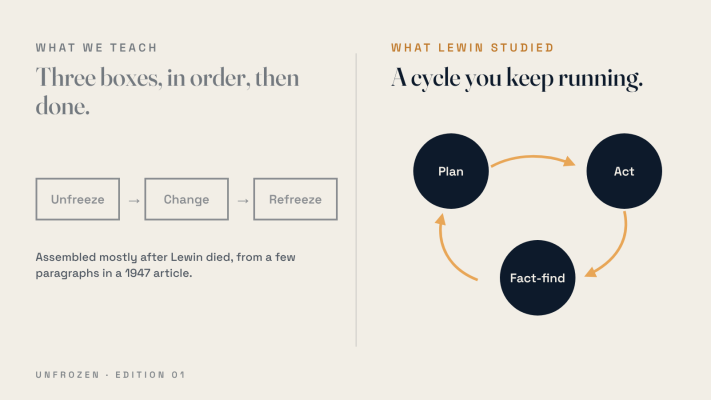
If you've ever sat through change management training, you've probably seen three boxes. Unfreeze. Change. Refreeze. Arrows in between. Kurt Lewin's name underneath.
I've drawn those boxes myself. In business school I wrote a paper on them and compared the model to thawing a meal for dinner. In my doctoral program I wrote about it again. I liked it because it was simple, and simple is useful when you're trying to get a room full of people to agree on what's happening to them.
Then I found out Lewin barely wrote about it.
What he actually said
Lewin was a psychologist who left Germany in the 1930s and spent the rest of his career in the U.S. studying how groups behave and how they change. He died in 1947. The unfreeze, move, freeze idea takes up only a few paragraphs of his writing, published the year he died. And he never wrote "refreeze." His word was "freezing." "Refreezing" came from one of his former students after he was gone.
In 2016, Stephen Cummings, Todd Bridgman and Kenneth Brown traced how those few paragraphs became the three-box model everybody teaches. Their argument is that the model was mostly assembled by other writers after Lewin was gone, and his name became the founding story for an entire field of change management.
Not everyone agrees the model was built by other people. Bernard Burnes has spent two decades defending Lewin, and in 2020 he argued that the three steps were Lewin's own, grew out of his larger work, and were never meant to stand alone.
Either way, that larger work is the part most of us never learned. Lewin built field theory, the idea that behavior comes from the person and their environment together. He also coined the term "group dynamics" and spent years showing how much groups shape what their members do.
One of his best-known studies came during World War II. Meat was rationed, and the government wanted families to eat less popular cuts, like hearts and kidneys. Lewin tested two approaches with groups of homemakers: a lecture on why they should, or a discussion where they talked it over and decided together. A week later, about half the discussion group had served the new meats. Only one in ten from the lecture had.
People change more when they decide together than when they're told. That idea runs through his third contribution, action research: study a problem by working on it with the people living it, then adjust as you learn. It's one of the foundations of OD. The three boxes were one piece of all this, and we've been teaching that piece as if it were the whole thing.
Why this is more than trivia
When I wrote that business school paper, I said refreezing seemed outdated. I didn't have a great reason. It was a gut feeling from watching how fast things moved around me.
That feeling has only gotten stronger. At a startup where I ran people operations, we picked a recruiting system, got the hiring managers using it, and moved on to the next fire. Then the contract came up for renewal in the middle of a hiring push. That date forced a question nobody had asked since we signed: is this still the right fit? It wasn't. Another system was cheaper and matched how we actually interviewed, so we switched.
The first system worked fine. What changed was us. After hiring with it for a while, we had a much clearer picture of how we actually interviewed candidates, and we could see the system wasn't set up for that. That stretch of using it was our fact-finding, the step in Lewin's cycle where you learn what actually happened. What we never planned was a point to act on it. We only asked because a contract forced us to. Without that date, we'd have kept paying more for a worse fit and called it stability.
Christopher Worley and Susan Mohrman asked the question directly in 2014: is change management obsolete? Their answer was mostly yes. The traditional models were built for a slower world. They're still useful, but they can't carry the load alone, so they proposed what they call "engage and learn," where change runs as ongoing routines instead of a project. One part I'd push back on: they lump Lewin's action research in with the old step-by-step models. But their own approach is to act, watch what happens and adjust, which is close to the cycle Lewin described in 1946: plan, act, fact-find. The fix they're proposing looks a lot like Lewin's real work.
Where I've landed for now:
The problem in most organizations isn't that leaders fail to refreeze. It's that they're still trying to.
They treat stability as the goal and change as the interruption.
The teams I've seen handle change well flip that. They expect the next change. They build feedback that actually goes somewhere, and they trust people closest to the work to adjust without waiting for a new rollout plan.
Try this on Monday
The next time you roll out a change, whether it's a new process, a new tool or a reorg, schedule the review before you launch. Pick a date 60 to 90 days after go-live and put it on the calendar. Invite the people doing the work, not just the people who approved it.
When that date comes, run it like an Army after-action review. What was supposed to happen? What actually happened? Why the difference? What do we change?
That's the habit: every change gets a review date, set before launch and held after. Announce it on day one. It tells people the change isn't set in stone, and it gives anyone with doubts a better place to raise them than the break room.
What Unfrozen is
This newsletter is where I go deeper on what I post each week. Each edition takes one idea from organizational development and asks two questions: what does the research say, and does it hold up in practice? To answer the second, I draw on change in the news, conversations with people who've led it, the stories you share in the comments, and my own experience. Some of it will challenge things I used to believe. That's the point.
Over the next few editions, I'm going to put my own working model on the table and test it here, in the open. When it breaks, I want to hear about it.
Unfrozen is dedicated to Dr. Peter Sorensen, who helped build the OD doctoral program at Benedictine University and took a chance on me. He was a pioneer in this field and spent his career connecting theory to practice. His legacy lives on in the people he taught and inspired.
Your turn
What's a management rule you were taught that fell apart the first time you used it? Tell me in the comments. I read all of them, and the best ones may end up in a future edition.
Sources
Burnes, B. (2004). Kurt Lewin and the planned approach to change: A re-appraisal. Journal of Management Studies, 41(6), 977–1002. https://doi.org/10.1111/j.1467-6486.2004.00463.x
Burnes, B. (2020). The origins of Lewin's three-step model of change. The Journal of Applied Behavioral Science, 56(1), 32–59. https://doi.org/10.1177/0021886319892685
Cummings, S., Bridgman, T., & Brown, K. G. (2016). Unfreezing change as three steps: Rethinking Kurt Lewin's legacy for change management. Human Relations, 69(1), 33–60. https://doi.org/10.1177/0018726715577707
Lewin, K. (1946). Action research and minority problems. Journal of Social Issues, 2(4), 34–46. https://doi.org/10.1111/j.1540-4560.1946.tb02295.x
Lewin, K. (1947a). Frontiers in group dynamics: Concept, method and reality in social science; social equilibria and social change. Human Relations, 1(1), 5–41. https://doi.org/10.1177/001872674700100103
Lewin, K. (1947b). Group decision and social change. In T. M. Newcomb & E. L. Hartley (Eds.), Readings in social psychology (pp. 330–344). Henry Holt.
Worley, C. G., & Mohrman, S. A. (2014). Is change management obsolete? Organizational Dynamics, 43(3), 214–224. https://doi.org/10.1016/j.orgdyn.2014.08.008
The views expressed here are my own and do not represent the views of my employer, the U.S. Government, or any organization I’m affiliated with.