I reenlisted once, in Afghanistan. Later, I left the Army a few months before I would have been considered for E-7. I was leaving a career full of management experience, instructor time and strategic planning. Then I couldn't find work, or at least not meaningful work. I ended up in a call center job, and I was miserable. So miserable that it pushed me to finish an 18-month MBA program in 10 months. I had led teams under the stress of combat. Why couldn't I lead one in a calm office?
Many veterans were middle managers long before they had a civilian job. This special edition is about a question employers rarely ask: when you hire that experience, do you recognize it, place it well and use it?
I spent eight years in the Army and left as a Staff Sergeant, a noncommissioned officer (NCO). An NCO trains the people they lead and turns orders from above into work those people can actually do. That's much of what a team lead or supervisor does in your company.
So when a veteran leaves a civilian job early, the usual question is whether they "fit in." I think that's the wrong question. The better one is whether the role fit what they already know how to do, starting with the hiring decision itself.
This edition asks two questions.
1. What do we actually know about veteran retention?
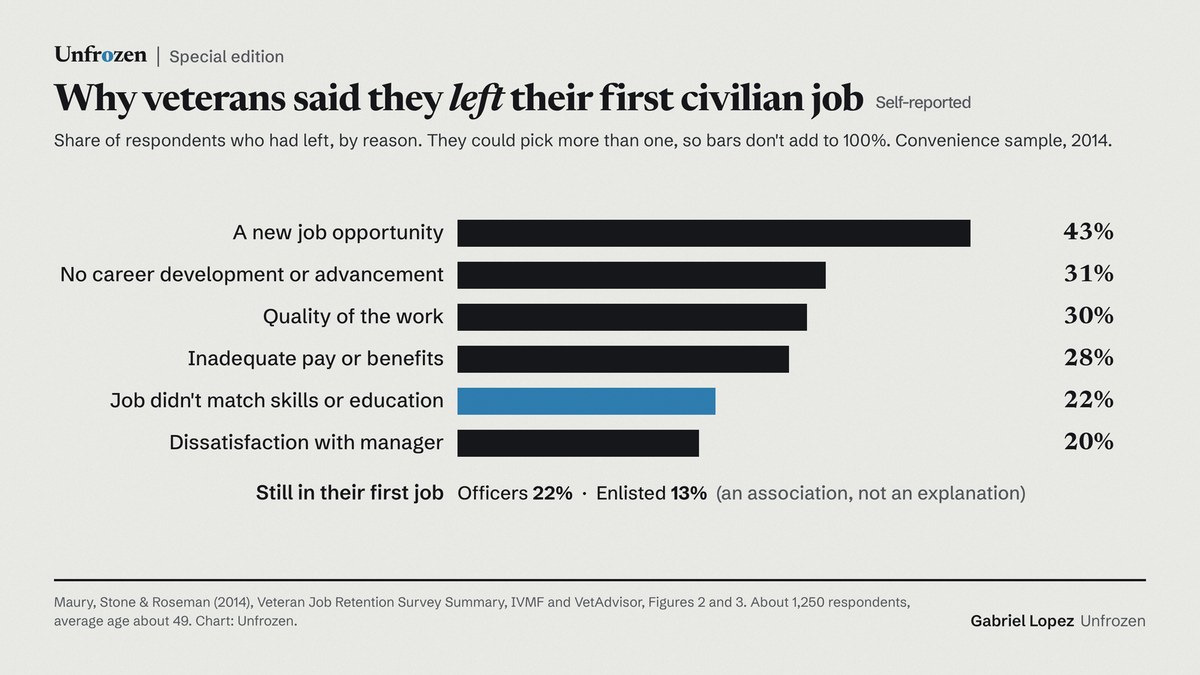
You have probably seen a version of "half of veterans leave their first job within a year." It traces back to a 2014 convenience survey of about 1,250 veterans by IVMF and VetAdvisor: of the respondents who had left their first post-military job, nearly half left within a year, most often for a new job opportunity. The respondents' average age was about 49, so it says more about earlier transitions than about today's. Two details in that survey matter here. Officers were more likely than enlisted respondents to still be in their first job (22% against 13%). That's an association, not an explanation, but rank is already visible in who stays. And when those who left were asked why (they could pick more than one reason), 31% cited a lack of career development or advancement, 30% the quality of the work, 28% inadequate pay or benefits, 22% a position that didn't match their skills or education, and 20% dissatisfaction with their manager. Those are self-reported reasons, not causes, and they don't validate a model. But they point toward four questions worth investigating: the career path, the pay, whether experience is used, and the manager.
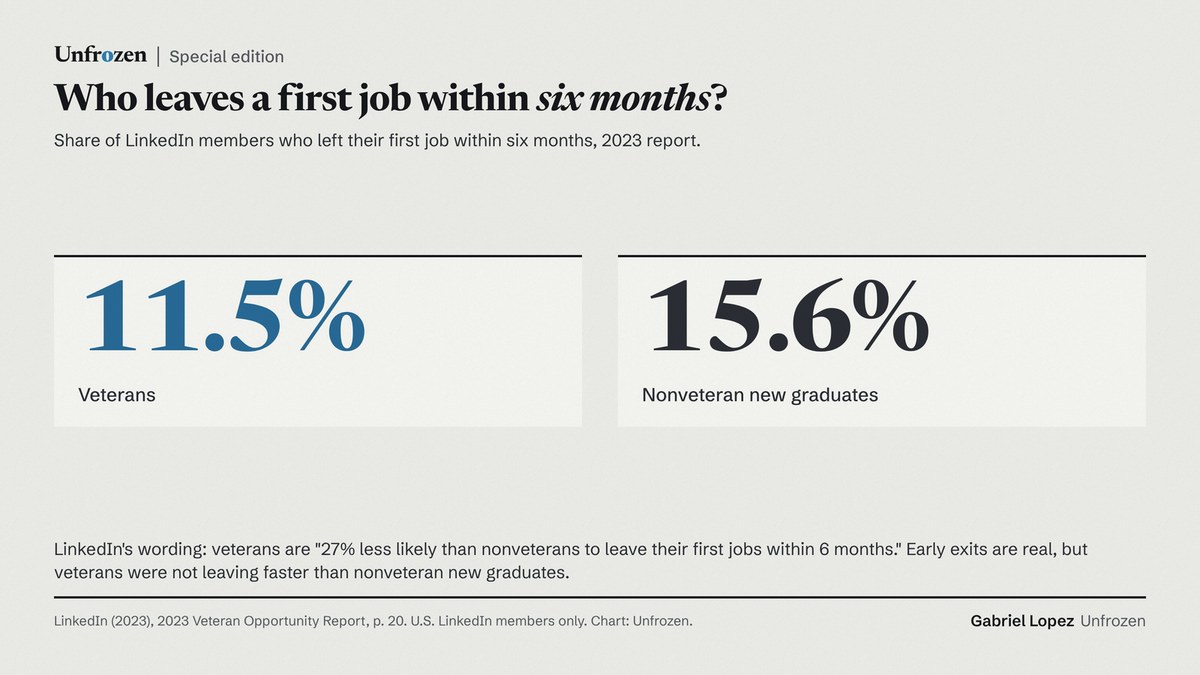
LinkedIn's own numbers point the other way. Its 2023 Veteran Opportunity Report finds veterans "27% less likely than nonveterans to leave their first jobs within 6 months": 11.5%, against 15.6% of nonveteran new graduates. Its 2019 report, on members with at least a bachelor's degree who started civilian careers between mid-2012 and mid-2019, found veterans stayed with their first employers 8.3% longer. LinkedIn names that study's limit: about half its veterans were likely officers, against about 15% of the military, so it "is not indicative of the broader veteran community." Both reports cover LinkedIn members only.
Here's my read. Early exits are real, but some are people moving up, not people failing. If your veteran hires leave, the first thing to check is where they went and why.
2. What's linked to veterans leaving: the work, the pay, or the level?
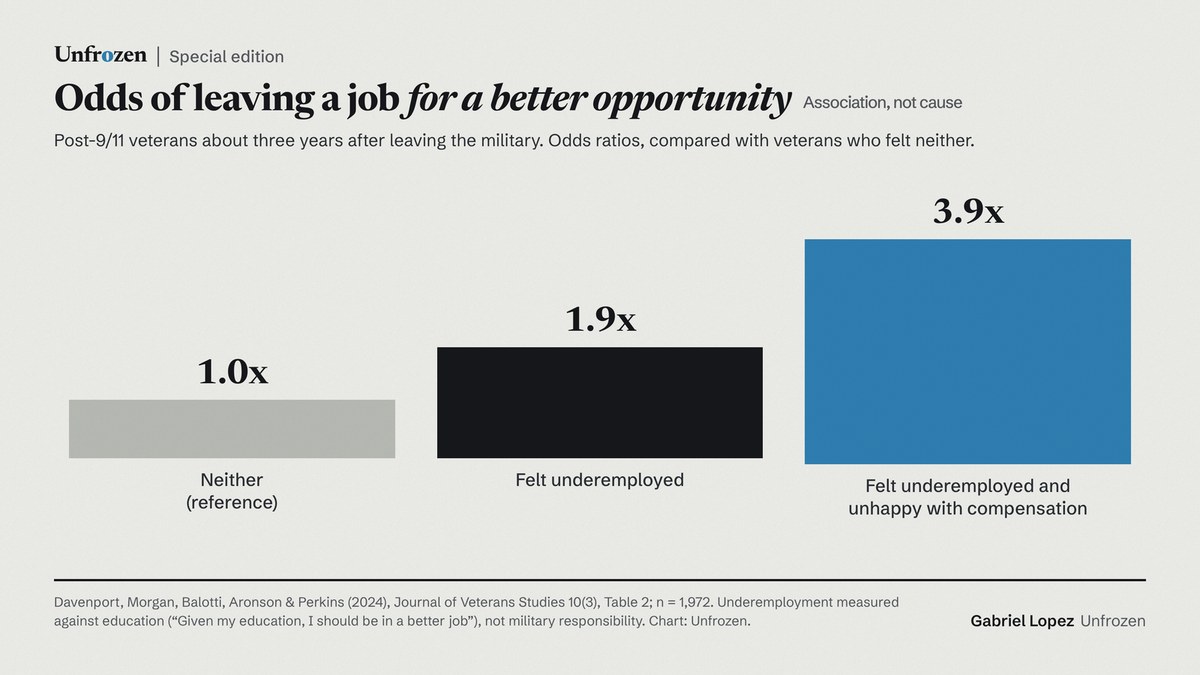
The clearest answer I found is about underemployment. In a 2024 peer-reviewed study of 1,972 post-9/11 veterans about three years after they left the military, Davenport and colleagues at Penn State compared veterans with those who reported neither problem: veterans who felt underemployed had 1.9 times the odds of leaving their job for a better opportunity, and those who felt both underemployed and dissatisfied with their pay had 3.9 times the odds. These are associations, not causes, and notice what was measured: leaving for something better, which echoes the 2014 survey's most common reason for leaving, a new opportunity. The study defines underemployment by education ("Given my education, I should be in a better job than my current job"). It doesn't measure a job below what they used to lead. An earlier 2022 study by some of the same researchers did ask about that, according to its abstract: it measured underemployment as a perceived mismatch with the skills, education or leadership experience veterans gained in service, and found enlisted veterans reported more of it. So the feeling of a job below your leadership experience has been measured. What I haven't found is evidence that this specific leadership-experience mismatch predicts turnover, or that employers can reliably identify and address it. That is the gap the Rank-to-Role Model wants to investigate.
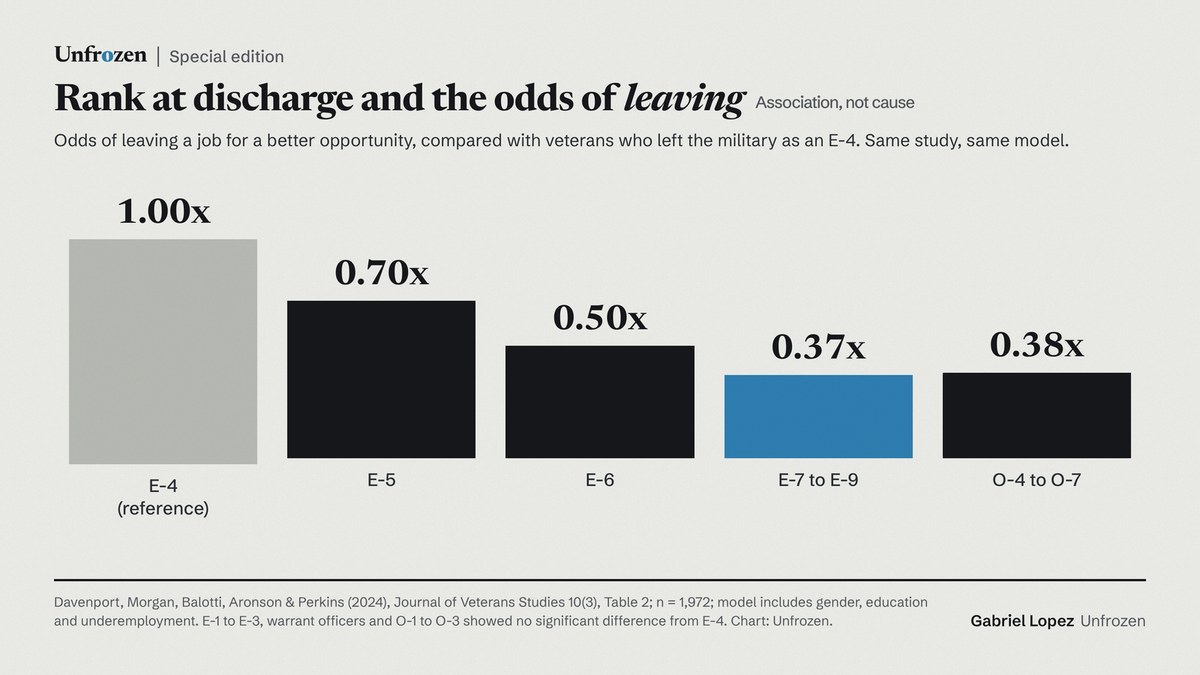
The same study holds a finding that matters for this model. In the same analysis, which accounts for gender, education and underemployment, rank at discharge was linked to who left. Compared with veterans who left the military as an E-4, those who left as an E-5 had 30% lower odds of leaving a job for a better opportunity, E-6 50% lower, E-7 to E-9 63% lower, and officers at O-4 and above 62% lower. The paper doesn't say why, and it doesn't say what jobs these veterans held. But it gives me a reason to investigate prior rank alongside role fit, rather than treating all veterans as one group. That is the "rank" in Rank-to-Role.
Level shows up in promotions too. LinkedIn's 2023 report finds veterans "half as likely to reach director or vice president leadership roles despite having nearly 2x more work experience than nonveterans." That experience includes military years, and the comparison covers LinkedIn members reaching those roles from 2018 to 2022.
A fair caveat. I haven't found a study that measures how former NCOs perform as civilian managers, so I won't claim veterans make better managers. My own count shows how thin this ground is: in the Unfrozen Research Index, 3 of 24,443 abstracts supplied by OpenAlex, from 28 management and organizational development journals (2007 to 2026), mention NCOs. That's a keyword count of how often these abstracts name them, not proof that no one has studied them. And the boss matters in a way that cuts against easy fixes: in a trial across 35 organizations, training supervisors to support veteran employees showed no evidence of a direct effect on veterans' health and work outcomes, according to the study's abstract. It helped only for veterans who already reported higher supervisor and coworker support. That trial tested one training program. It doesn't tell us whether a supportive boss matters; the 2014 survey suggests it does.
For employers, the question is bigger than whether a veteran stays. It's whether the organization recognized the experience it hired in the first place. When RAND interviewed 26 companies in the 100,000 Jobs Mission in 2014, it found that military-specific skills were harder for employers to understand and appreciate than skills with an obvious civilian match, that programs focused on recruiting, and that companies "do not tend to collect metrics about veteran performance and veteran retention." Its advice was to take veteran programs beyond recruitment and to track performance and retention. A veteran hiring program can hit its recruiting targets and still struggle with placement, development and retention. Without looking at those outcomes, an employer may never know whether it's getting full value from the experience veterans bring.
Why it matters
If you hire a former squad leader into a role well below what they ran, you may be paying for experience the job never uses. Military rank doesn't translate directly into a civilian job grade, which is exactly why the match needs checking. That mismatch may never show up as a complaint. It may show up as a resignation that everyone calls "a better opportunity."
It may not show up in the data either. More than a decade after RAND's interviews, I still ask how many veteran programs could show who they kept and promoted, not just who they hired.
The Rank-to-Role Model, version 0.1
I'm building a working model in the open: the Rank-to-Role Model, a proposed framework for evaluating how well a civilian role fits a veteran's experience. It names four conditions that may help explain whether a veteran stays.
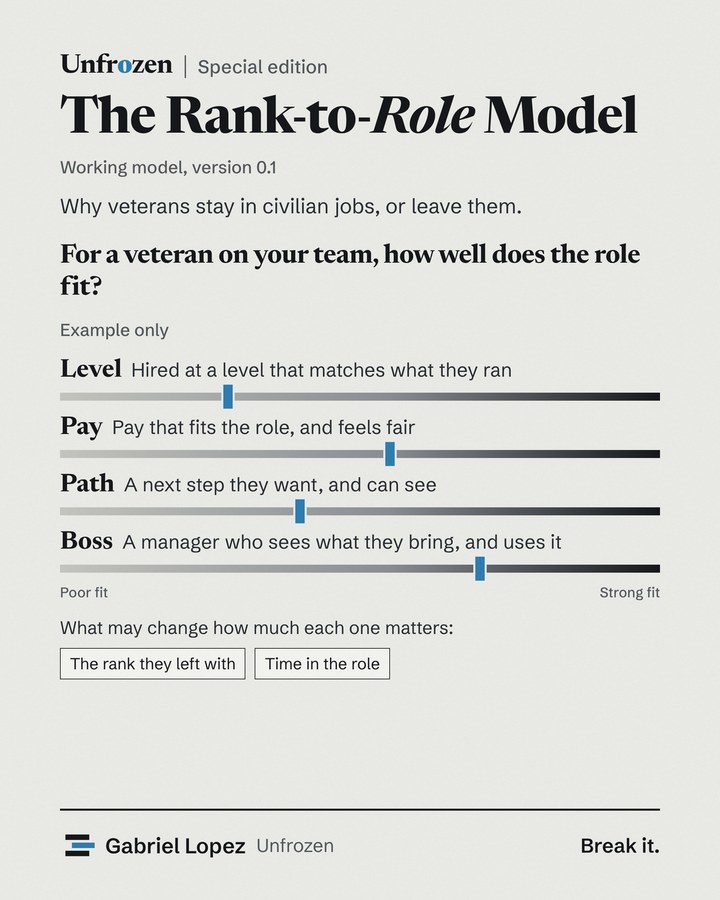
- Level: the role they're hired into, compared with the responsibility they held before, from the hiring decision onward.
- Pay: pay that reflects the role's responsibility and feels fair.
- Path: a next step they want, and can see.
- Boss: a manager who understands what they bring and uses it.
Where it isn't proven: each condition has some evidence on its own, though the evidence on the boss is mixed. The combination is untested. And I don't yet know whether the four conditions matter differently by the rank someone left with, the civilian occupation they entered, or how long they've been out. I plan to test the model formally in my doctoral research. Eventually it could underpin a structured diagnostic covering hiring decisions, role responsibilities, development and retention. Version 0.1 is here so you can tell me where it breaks.
My lens
The low of that call center job is where my curiosity about veterans' job satisfaction started. Was it the pay? The lack of influence? The position itself? How could someone on a fast track not be considered qualified for a management job in a corporate setting? And how often does this happen to others? Those questions are where the Rank-to-Role Model began.
Try this on Monday: a 10-minute fit check
Pick anyone on your team whose earlier experience the role may not be using, and work through four questions with them. All four are better explored in conversation than filled in alone. Pay particular attention to experience from military service, because a rank doesn't read like a job title.
- Level: Do their current responsibility and decision authority match what they carried before, or sit well below it?
- Pay: Does their pay reflect the responsibility of the role, and do they see it as fair?
- Path: Can they name a next step they actually want, and roughly when?
- Boss: Does their manager understand what they did before, and use it?
If something gives you pause, keep the conversation going before the next review cycle does it for you. This isn't a validated assessment. It's the model turned into questions, and what you learn helps refine it.
The dare
If you're a veteran: how long did you stay in your first civilian job, and what made you stay or leave (the work, the pay, or the level)? Your answers will help inform version 0.2. Tell me on LinkedIn.
If you lead veteran recruiting, talent development or workforce planning: I'd like to know how your organization evaluates the fit between military experience and civilian roles. I'm looking for a few organizations willing to challenge the model's assumptions and help shape an initial pilot, starting with where military experience may be underused in your existing workforce. Message me.
How I counted: the 2014 figures are from a convenience sample, not a representative one; the reasons for leaving are from its Figure 3, among respondents who had left their first job, who could select more than one reason, and the officer and enlisted comparison is from its Figure 2. The LinkedIn figures cover its U.S. members; the 2019 comparison covers degree holders only, and the 2023 director and vice president comparison counts military years as work experience. The underemployment and rank figures are odds ratios from Table 2 of Davenport et al. (2024), one model that includes gender, education, underemployment and pay grade at discharge; underemployment is measured against education, not military responsibility, and E-1 to E-3, warrant officers and O-1 to O-3 did not differ significantly from E-4. The NCO count is a keyword search of OpenAlex abstracts in the Unfrozen Research Index; it misses papers that use other words.
Sources
Maury, Stone and Roseman (2014), Veteran Job Retention Survey Summary, IVMF and VetAdvisor, pp. 5 to 6. Archived copy.
LinkedIn (2023). 2023 Veteran Opportunity Report, pp. 5, 19, 20, 31.
LinkedIn (2019). Veteran Opportunity Report.
Davenport, K. E., Morgan, N. R., Balotti, B. A., Aronson, K. R., and Perkins, D. F. (2024). Underemployment, compensation dissatisfaction, job turnover, and salary change: How are post-9/11 veterans doing three years after leaving the US military? Journal of Veterans Studies, 10(3), 1 to 18, Table 2. doi:10.21061/jvs.v10i3.542. Summarized in Penn State VETERANetwork's March 2026 brief.
Davenport, K. E., Morgan, N. R., McCarthy, K. J., Bleser, J. A., Aronson, K. R., and Perkins, D. F. (2022). The subjective underemployment experience of post-9/11 veterans after transition to civilian work. Work, 72(4), 1349 to 1357. doi:10.3233/WOR-210029 (abstract only).
Hammer, L. B., Wan, W. H., Brockwood, K. J., Bodner, T., and Mohr, C. D. (2019). Supervisor support training effects on veteran health and work outcomes in the civilian workplace. Journal of Applied Psychology, 104(1), 52 to 69. doi:10.1037/apl0000354 (abstract only).
Hall, K. C., et al. (2014). Veteran Employment: Lessons from the 100,000 Jobs Mission. RAND Corporation, RR-836, p. vi and the report's key findings.
Unfrozen Research Index, OpenAlex abstracts, 28 journals, 2007 to 2026 (index v4d). Count and method.
The views expressed here are my own and do not represent the views of my employer, the U.S. Government, or any organization I'm affiliated with.